


IP Paris Doctoral School
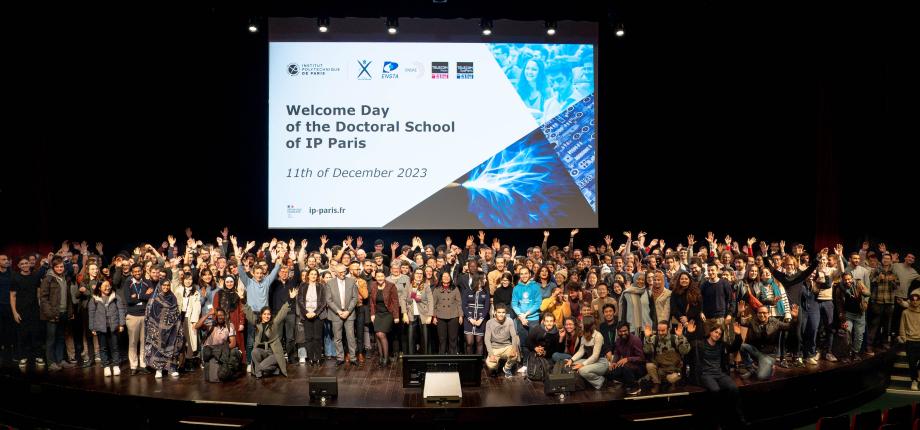
The doctoral school hosts around 900 doctoral students, supervised by more than 800 researchers (including 550 HDRs), in 30 research laboratories (UMR CNRS, INRIA, CEA), which offers a very important scientific strike force, demonstrated by their great national and international reputation and the high level of recognition achieved by the most eminent researchers. In addition to the academic environment of excellence, ED IP Paris also benefits from an important industrial connection (THALES, EDF, DANONE …), allowing the development of industrial partnership in particular with industrial R&D laboratories in Saclay. ED IP Paris offers a rich doctoral training through the research component ranging from basic research to applied research.The doctoral school of the lnstitut Polytechnique de Paris is extremely open to international recruitment (currently, foreign doctoral students represent 45% of PhD students).
The PhD program at ED IP Paris prepares students for successful scientific career opportunities (research, teaching, project management, etc.) in universities and the private sector. For general information, please contact the Administrative Department of the ED IP Paris.
The doctorat framework at the Doctoral School of Institut Polytechnique de Paris
Research Areas
-
Social sciences and Management
-
Department of Humanities, Art, Literature and Languages
Your arrival at Institut Polytechnique de Paris

Adriana Tapus Head of Doctoral School IP Paris
How to be admitted to IP Paris Doctoral School?
Admission is subject to the submission of an application file via the ADUM platform
There are two possible ways to be admitted to a PhD program at IP Paris Doctoral School
Establish contact with a researcher holding HDR (habilitation) at one of the laboratories of the Institute Polytechnique de Paris and develop a thesis project along with an application for funding. Typically, this process is initiated in the midst of the second year (M2), coinciding with the selection of a research internship. After compiling the necessary documents, including comprehensive details of the thesis project, CV, M2 transcript of grades, and a letter of motivated support from the thesis supervisor, agreements between the laboratory and the hosting doctoral school can be secured. Subsequently, the application is to be submitted through ADUM.
Institut Polytechnique de Paris supports multiple types of funding
The programs financially supported or coordinated by the Institut Polytechnique de Paris (MESR, AMX, Hi! PARIS, EUR Plasmas, E4C, E4H, and STEP2)
- Supported fundings by research organizations, such as: ONERA, CEA and CNRS
- Supported fundings by other organizations
Online application to the doctoral programs of the Institut Polytechnique de Paris Doctoral School
Registration and re-registration
The academic period is from September 1st to August 31st of the year following your re-registration. Re-registrations must be completed between September 1st and August 31st, irrespective of the thesis starting date. Doctoral students in their 4th year who successfully defend their thesis before December 31st are exempt from re-registration, tuition fees, and the obligation to subscribe to the CVEC.
- Full tuition fees will be charged for any academic year commenced, with no prorated fee, irrespective of the thesis start date.
- Registration and re-registration process of the Doctoral School of the Institut Polytechnique de Paris
If you have questions on registrations/re-registrations, feel free to contact us here
Doctoral programs and funding
The Institut Polytechnique de Paris implements a doctoral admission policy that aims to adhere to the following principles :
- Explicit and public criteria and procedures made known to all members of the institution and the potential doctoral candidates
- Consideration of the personalized and high-quality supervision within the units and research teams
- Recruitment that promotes gender equality, diversity, and openness, particularly on the international level
- A recruitment encouraging the development of new research avenues and attentive to consider the professional integration prospects and career development of the doctors
- Possible guidance or direction
The Institut Polytechnique de Paris supports multiple types of funding :
- The programs financially supported or coordinated by the Institut Polytechnique de Paris (For example : MESR, AMX, Hi! PARIS, EUR Plasmas, E4C and E4H)
- Supported funding by research organizations (For example : ONERA, CEA and CNRS
- Supported funding by other organizations
Doctoral contracts examination
The Institut Polytechnique de Paris organizes two calls :
- Early call
- Final call
Admission criteria
The Doctoral School considers in the selection of the doctoral candidates :
- The academic results previously obtained by the candidate, notably during the higher education period
- The candidate’s research ability, particularly evaluated from the beginning of the research internship period
- The alignment between the candidate’s education and the doctoral project
- The originality and the feasibility of the doctoral project within the context of the research unit and its partners
- The doctoral project’s alignment with the scientific policy of the research unit, through the approval of the director of the research unit during the registration
- DThe availability and the capacity of the thesis directors and all supervisors to ensure the scientific guidance of the doctoral project
- A career project expressed by the candidate and its coherence with the doctoral project
The terms of choice and selection of the doctoral candidates are subject to a procedure defined by the executive office and approved by the Doctoral School council.
Compilation of files
The candidate’s file requires the following information:
- The application form
- Curriculum Vitae
- Cover letter
- M1 & M2 transcripts or other international diplomas
- Two recommendation letters
Terms of examination of files and selection to the interview
- Supervisors’ opinions for each application on its subject
- Laboratory directors’ opinions for each application in their laboratory
- Pre-selection of candidates’ applications by scientific domains of the Doctoral School for the interview, based on the application file.
- Each application will be examined by the jury, taking into account the academic background (including internships completed by the candidate), the quality of supervision, the alignment of the candidate’s profile with the thesis topic, and potential interdisciplinarity, and also providing an overall rating
- The IP Paris Arbitration Board/Commission
- Interviews by scientific fields
The interviews can take place in French or English
The interviews shall include the following elements :
-
Briefly (~2’): Presentation of the Curriculum Vitae (academic course, internships…)
-
Presentation of the thesis subject (~5-10’): The candidates should be able to clearly explain the subject, its challenges and issues as a whole, including the aspects within the field of a discipline other than the candidate’s original subject if it is interdisciplinary
-
Briefly (~2’): Motivation for the subject and professional prospects/perspectives.
-
The presentation will be followed by a Q&A session (5-10 minutes)
At the end of the auditions, the evaluations could be updated by the members of the disciplinary jury considering the candidates’ performance.
Constitution of the final arbitration board/commission
The jury of the final arbitration will include:(the same person can represent several entities)
- The Director of the IP Paris Doctoral School
-
The Director or Deputy Director representing the EDMH
-
The Research Vice-President of IP ParisA representative per institution whose thesis funding is concerned by the competition
- A representative of each disciplinary jury
- A representative of each IP Paris Doctoral School field
- A representative of the jury of Hi! PARIS/E4C/E4H/etc
2024 Calendar
Early call
- Deadline for thesis subject deposits on ADUM: January 15, 2024
-
Deadline for applications on ADUM: February 15, 2024
- Interview of candidates: From March 6-15, 2024
- Publishing of the early call results: Beginning of April 2024
Final call
- Deadline for thesis subject submission on ADUM: March 15, 2024
-
Deadline for applications on ADUM: April 15, 2024
-
Interview of candidates: From May 13-24, 2024
- Publishing of the final call results: Beginning of June 2024
CIFRE Thesis
If you need a supporting letter of the Doctoral School for the ANRT of your CIFRE thesis
Fill out this form
Presentation of the Thesis Monitoring Committee (annual evaluation)
In the context of the thesis monitoring committee of the doctoral students enrolled in the IP Paris Doctoral School, we request that a presentation be organized within the lab in the presence of two members of the individual monitoring committee before each re-registration throughout the thesis duration. Learn more here
Le comité de suivi individuel du doctorant veille au bon déroulement du cursus en s'appuyant sur la charte du doctorat et la convention individuelle de formation. Il évalue, lors d’entretiens avec le doctorant, les conditions de sa formation et les avancées de sa recherche. Il formule des recommandations et transmet des rapports d’entretiens au directeur de l'école doctorale, aux responsables de domaines, au doctorant et au directeur de thèse. Il veille notamment à prévenir toute forme de conflit, de discrimination ou de harcèlement.
Afin d’accompagner les membres des comités de suivi dans leur mission, le réseau national des collèges doctoraux a publié un guide du CSI (comité de suivi individuel) des doctorants, qui peut être consulté sur ce lien
La fourniture du rapport du comité de suivi individuel est un préalable à l’inscription pour l’année suivante.
Les présentations sont organisées sous la responsabilité et à l’initiative du directeur de thèse. Ses modalités sont les suivantes :
- Envoi par le doctorant, deux semaines avant la présentation, d’un manuscrit (10 pages maximum hors bibliographie) introduisant le sujet, les travaux réalisés et les résultats obtenus ainsi que les perspectives d’avancement jusqu’à la soutenance, et une liste de l’ensemble des communications et publications éventuelles, ainsi qu’un CV.
- Le doctorant fournit deux semaines avant la présentation son projet professionnel et la liste de ses formations suivies et prévisionnelles, ainsi que le formulaire de rapport du comité de suivi prérempli avec les données.
- Le doctorat fait sa présentation (20-25’ suivie de questions-réponses) aux deux membres du comité de suivi, dont l’un est désigné président, suivi d’un entretien de ces membres avec le directeur de thèse seul et d’un entretien de ces membres avec le doctorant seul.
- Rédaction d’un rapport consensuel par les deux membres extérieurs du comité de suivi, signé par le président. Celui-ci est communiqué au doctorant et au directeur de thèse, qui pourra éventuellement y porter ses commentaires. Il est ensuite remis au responsable de domaine.
Nous vous demandons d'assister à la présentation du doctorant et de discuter seul à seul avec lui, puis avec son directeur de thèse pour évaluer si la thèse se déroule de façon satisfaisante. A l'issue de cette présentation, nous vous remercions de remplir le formulaire ci-joint et de l'envoyer au doctorant et au directeur de thèse. Le rapport devra répondre succinctement aux questions suivantes :
- Pertinence du travail effectué
- Evaluation de ce qui reste à faire
- Avis sur le calendrier prévisionnel de soutenance proposé
- Sondage sur le devenir du doctorant après sa thèse
- Production scientifique (publications, logiciels, rapports, …)
- Evaluation et signalement d’une situation de conflit, d’harcèlement, de discrimination, de violences sexistes ou sexuelles (HDVSS)
Training Courses
In addition to personalized training through research acquired during the activity within the research unit, the doctoral training also includes the participation in different collective drills intended :
- to fortify the scientific culture of the doctoral students, especially in their scientific field
- to prepare their professional integration or the pursuit of their career in both the public and private sectors
- to encourage their international exposure
These trainings are of three types: scientific, linguistic, and transversal. The latter including ethics and scientific integrity, is a part of the training obligations for all doctoral students, pursuant to the decree of 25 May 2016 (modified on 26 August 2022) on the PhD degree.
The trainings should help the doctoral student on one hand to be more effective in his/her doctoral project and on the other hand to prepare his/her professional future. The training choice will have to be done according to these two objectives and will be able to rely on the earnest advice of the thesis supervisor.
Each doctoral student ought to pursue on the duration of his/her thesis at least 100 hours of training distributed as follows:
- Scientific trainings: 40 to 60 hrs including 20 opening hrs (off thesis subject);
- Transversal trainings: 40 to 60 hrs including mandatory ethics training.
- Language trainings : 0 to 20 hrs
The duty to complete 100 training hours can be reduced in the following cases
| Situation/Event | Nature of the exemption | Steps to follow |
| Joint PhD thesis |
The number of hours to be carried out is proportional to the time of presence in France and in accordance with the joint PhD agreement.
|
Void/None |
| Thesis in CIFRE Convention |
Exemption from the obligation to follow the transversal trainings (40 to 60 hrs) except ethics and integrity training. |
Void/None |
| Thesis in professionnal training |
Total or partial exemption to follow the transversal trainings (40 to 60 hrs) except ethics and integrity training, by the decision of the Doctoral School Management. |
Make a request to the Doctoral School |
|
Investment in volunteer work (doctoral associations, general purpose, etc.)
|
Exemption of 5 hrs under the transversal trainings per year of investment.
|
Form to deliver in the off-catalog trainings. Supporting document to submit.
|
|
Complementary teaching activities, mediation/arbitration, expert mission
|
Exemption of 10 out of 64 hrs of (or pro rata) limited to 30 hrs over the thesis duration under the transversal trainings.
|
Form to deliver in the off-catalog trainings. Certificate of attendance and total number of hours (see with the Student Affairs Service of the supervising institution).
|
|
Simultaneous curriculum tracking
|
Total or partial exemption from the obligation to follow the transversal trainings (40 to 60 hrs) except ethics and integrity training, by the decision of the Doctoral School Management.
|
Make a request to the Doctoral School |
Transversal and linguistic trainings will be described and announced as a catalog on ADUM. Registration is also done on ADUM. They are validated according to the following rule :
ADUM Catalog of training courses (validation under transversal trainings subject to exception)
| Type of training courses | Validation | Condition of validation |
|
Individual thesis support and post-thesis preparation
|
|
At least 75% training attendance and reply to ADUM evaluation survey.
|
| Languages |
Total validation of the justified number of hours limited to 20 hrs throughout the thesis duration. |
At least 75% training attendance and reply to ADUM evaluation survey. |
| The welcome Day |
Validation of maximum 3 hrs per year under the scientific trainings. |
Reply to ADUM evaluation survey |
| MOOC |
Validation of half the minimum number of hours required to confirm the MOOC, limited to 20 hrs per MOOC and 40 hrs throughout the thesis duration. |
Certificate transmission and reply to ADUM evaluation survey.
|
|
French theater club
|
Validation of 7 hrs per year of investment limited to 21 hrs throughout the thesis duration | Reply to ADUM evaluation survey |
For the off-catalog training courses, especially scientific trainings (thematic schools, master modules, conference, or seminar cycle…), the validation is not automatic but can be approved by the research field supervisor after declaration on ADUM.
Off-catalog courses (request on ADUM)
| Type of training course | Validation |
Documents to send with your request
|
|
Scientific courses in connection with the thesis
|
Request validation by the Thesis Supervisor and the Research Field Supervisor limited to 50% of the total number of training hours. |
|
| Opening scientific course |
Validation by the Thesis Director and the Research Field Supervisor of the total justified hours of attendance of at least 75% of the total courses.
|
Signed attendance sheet or certificate of attendance |
|
Courses of IP Paris schools (Masters, Cycle Polytechnicien, Engineering)
|
Validation by the Thesis Director and the Research Field Supervisorr of the total justified hours of attendance of at least 75% of the total courses.
|
Certificate of participation |
| Training courses and seminars of Collège de France |
After prior agreement with the doctoral school, validation of the actual training hours under the scientific training courses. |
|
|
Thematic Schools (summer school)
|
Validation limited to two thematic schools and 30 hrs per theme under the scientific training courses. |
Certificate of participation |
|
External transversal training courses
|
Validation of the total justified hours of attendance of at least 75% of the training (for compulsory courses) or the totality (for courses from 1 to 3 consecutive days) subject to appropriate level /relevance of the content. |
|
| In-company professional training |
Validation limited to 20 hrs subject to appropriate level/relevance of the content under transversal or scientific training courses according to the qualifying actions |
Certificate of participation, program, and contents.
|
| Opening seminars
(off thesis focus)
|
Validation limited to 20 hrs throughout the thesis duration. | Certificate of participation |
|
Science Fair
|
Trainings as follows: - Stand animation and activities: 4 hrs of daily training. - Laboratory visits achievement: all hours worked/done. - Realization of a short conference such as TED (Technology, Entertainment, Design) on the doctoral student’s research topic (after preliminary training organized by the Doctoral School): 7 hrs |
Certificate of participation |
|
Tutorial (conference short courses, etc.)
|
Validation of all duly justified hours.
|
Certificate of participation, program, and contents.
|
| MOOC |
Validation of half of the minimum hours required to approve the MOOC, limited to 20 hrs per MOOC and 40 hrs throughout the thesis duration, as part of the transversal or scientific courses according to the training actions.
|
Certificate of participation or other certificate
|
Attention: Conferences/workshops within the thesis research domain, seminars close to the thesis topic and laboratory seminars are not considered.
PhD defense
PhD Thesis Award
The Institut Polytechnique de Paris will award annually three prizes to the students who have produced the best PhD thesis and made the most outstanding contributions in one of the following fields: Physics; Biology and Chemistry; Information, Communications, Electronics; Computer Science, Data, and Artificial Intelligence; Engineering, Mechanics, and Energetics; Economics, Management, and Social Sciences.
PhD thesis awards 2022


Directory of PhD students and Doctors
Golden Rules for PhD Supervision at Institut Polytechnique de Paris
Thesis subjects
The individual monitoring committee
Demande de dérogation portant sur le nombre de doctorants dirigés par le même directeur de thèse
2023 PhD Graduation Ceremony
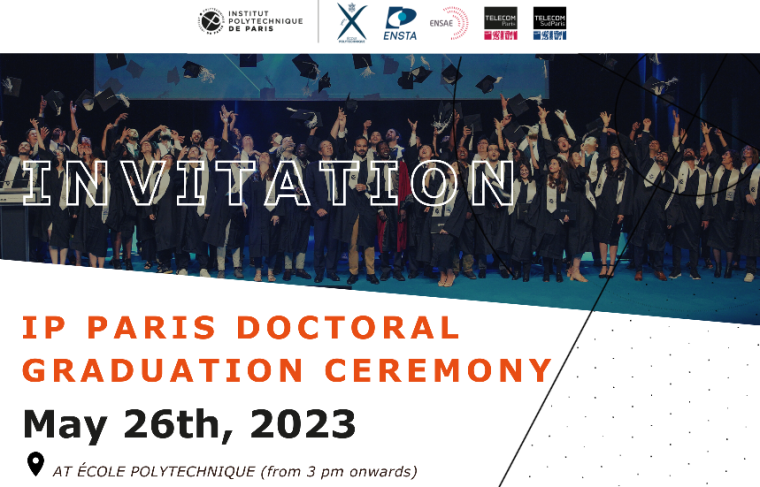
The IP-Paris PhD graduation ceremony will take place on Friday May 26th, 2023 at amphithéâtre Poincaré at Ecole Polytechnique.
Useful documents
Documents required for the first enrollment
Other case
Documents required for the re- enrollment
Documents required for the fourth re-enrollment
Defense
- Procédure de soutenance
- Modèle de couverture (Docx)
- Modèle de couverture (odt)
- Modèle de couverture (Latex)
- Déclaration de maîtrise de la langue de rédaction
- Engagement de confidentialité public
- Demande de soutenance Huis clos
- Accord de confidentialité jury avec huis clos
- Accord de confidentialité rapporteur avec huis clos
- Mise en place accord confidentialité sans huis clos
- Accord de confidentialité jury sans huis clos
- Accord de confidentialité rapporteur sans huis clos
- Demande de participation à une soutenance en visio
- Autorisation à filmer la soutenance
- Formulaire de rectification STEP
Aditionnal Documents
Contact
- Enrollment/Re-enrollment
- Procédure of thesis defense
- Césures
- International Co-supervision
- Thesis under a CIFRE agreement. If you need a letter of support from the doctoral school for your CIFRE thesis, complete this form.
- Graduation
- Training courses
- Organization Chart Graduate School
Address
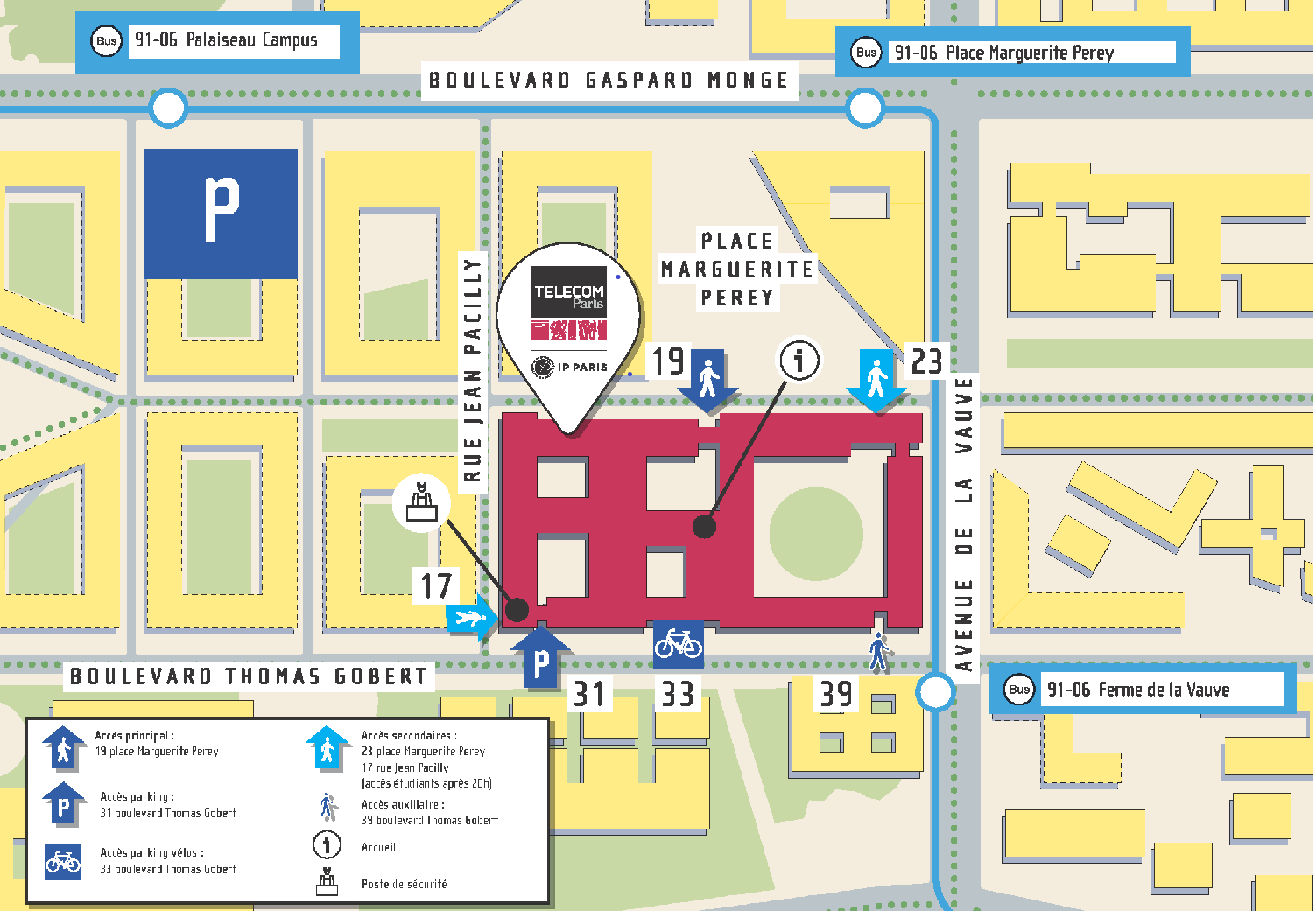
Graduate School IP Paris pôle Doctorat
Télécom Paris
19, place Marguerite Perey
5ème étage - CS 20031
F-91123 Palaiseau Cedex
The doctoral school hosts around 900 doctoral students, supervised by more than 800 researchers (including 550 HDRs), in 30 research laboratories (UMR CNRS, INRIA, CEA), which offers a very important scientific strike force, demonstrated by their great national and international reputation and the high level of recognition achieved by the most eminent researchers. In addition to the academic environment of excellence, ED IP Paris also benefits from an important industrial connection (THALES, EDF, DANONE …), allowing the development of industrial partnership in particular with industrial R&D laboratories in Saclay. ED IP Paris offers a rich doctoral training through the research component ranging from basic research to applied research.The doctoral school of the lnstitut Polytechnique de Paris is extremely open to international recruitment (currently, foreign doctoral students represent 45% of PhD students).
The PhD program at ED IP Paris prepares students for successful scientific career opportunities (research, teaching, project management, etc.) in universities and the private sector. For general information, please contact the Administrative Department of the ED IP Paris.
The doctorat framework at the Doctoral School of Institut Polytechnique de Paris
Research Areas
-
Social sciences and Management
-
Department of Humanities, Art, Literature and Languages
Your arrival at Institut Polytechnique de Paris
Adriana Tapus Head of Doctoral School IP Paris
How to be admitted to IP Paris Doctoral School?
Admission is subject to the submission of an application file via the ADUM platform
There are two possible ways to be admitted to a PhD program at IP Paris Doctoral School
Establish contact with a researcher holding HDR (habilitation) at one of the laboratories of the Institute Polytechnique de Paris and develop a thesis project along with an application for funding. Typically, this process is initiated in the midst of the second year (M2), coinciding with the selection of a research internship. After compiling the necessary documents, including comprehensive details of the thesis project, CV, M2 transcript of grades, and a letter of motivated support from the thesis supervisor, agreements between the laboratory and the hosting doctoral school can be secured. Subsequently, the application is to be submitted through ADUM.
Institut Polytechnique de Paris supports multiple types of funding
The programs financially supported or coordinated by the Institut Polytechnique de Paris (MESR, AMX, Hi! PARIS, EUR Plasmas, E4C, E4H, and STEP2)
- Supported fundings by research organizations, such as: ONERA, CEA and CNRS
- Supported fundings by other organizations
Online application to the doctoral programs of the Institut Polytechnique de Paris Doctoral School
Registration and re-registration
The academic period is from September 1st to August 31st of the year following your re-registration. Re-registrations must be completed between September 1st and August 31st, irrespective of the thesis starting date. Doctoral students in their 4th year who successfully defend their thesis before December 31st are exempt from re-registration, tuition fees, and the obligation to subscribe to the CVEC.
- Full tuition fees will be charged for any academic year commenced, with no prorated fee, irrespective of the thesis start date.
- Registration and re-registration process of the Doctoral School of the Institut Polytechnique de Paris
If you have questions on registrations/re-registrations, feel free to contact us here
Doctoral programs and funding
The Institut Polytechnique de Paris implements a doctoral admission policy that aims to adhere to the following principles :
- Explicit and public criteria and procedures made known to all members of the institution and the potential doctoral candidates
- Consideration of the personalized and high-quality supervision within the units and research teams
- Recruitment that promotes gender equality, diversity, and openness, particularly on the international level
- A recruitment encouraging the development of new research avenues and attentive to consider the professional integration prospects and career development of the doctors
- Possible guidance or direction
The Institut Polytechnique de Paris supports multiple types of funding :
- The programs financially supported or coordinated by the Institut Polytechnique de Paris (For example : MESR, AMX, Hi! PARIS, EUR Plasmas, E4C and E4H)
- Supported funding by research organizations (For example : ONERA, CEA and CNRS
- Supported funding by other organizations
Doctoral contracts examination
The Institut Polytechnique de Paris organizes two calls :
- Early call
- Final call
Admission criteria
The Doctoral School considers in the selection of the doctoral candidates :
- The academic results previously obtained by the candidate, notably during the higher education period
- The candidate’s research ability, particularly evaluated from the beginning of the research internship period
- The alignment between the candidate’s education and the doctoral project
- The originality and the feasibility of the doctoral project within the context of the research unit and its partners
- The doctoral project’s alignment with the scientific policy of the research unit, through the approval of the director of the research unit during the registration
- DThe availability and the capacity of the thesis directors and all supervisors to ensure the scientific guidance of the doctoral project
- A career project expressed by the candidate and its coherence with the doctoral project
The terms of choice and selection of the doctoral candidates are subject to a procedure defined by the executive office and approved by the Doctoral School council.
Compilation of files
The candidate’s file requires the following information:
- The application form
- Curriculum Vitae
- Cover letter
- M1 & M2 transcripts or other international diplomas
- Two recommendation letters
Terms of examination of files and selection to the interview
- Supervisors’ opinions for each application on its subject
- Laboratory directors’ opinions for each application in their laboratory
- Pre-selection of candidates’ applications by scientific domains of the Doctoral School for the interview, based on the application file.
- Each application will be examined by the jury, taking into account the academic background (including internships completed by the candidate), the quality of supervision, the alignment of the candidate’s profile with the thesis topic, and potential interdisciplinarity, and also providing an overall rating
- The IP Paris Arbitration Board/Commission
- Interviews by scientific fields
The interviews can take place in French or English
The interviews shall include the following elements :
-
Briefly (~2’): Presentation of the Curriculum Vitae (academic course, internships…)
-
Presentation of the thesis subject (~5-10’): The candidates should be able to clearly explain the subject, its challenges and issues as a whole, including the aspects within the field of a discipline other than the candidate’s original subject if it is interdisciplinary
-
Briefly (~2’): Motivation for the subject and professional prospects/perspectives.
-
The presentation will be followed by a Q&A session (5-10 minutes)
At the end of the auditions, the evaluations could be updated by the members of the disciplinary jury considering the candidates’ performance.
Constitution of the final arbitration board/commission
The jury of the final arbitration will include:(the same person can represent several entities)
- The Director of the IP Paris Doctoral School
-
The Director or Deputy Director representing the EDMH
-
The Research Vice-President of IP ParisA representative per institution whose thesis funding is concerned by the competition
- A representative of each disciplinary jury
- A representative of each IP Paris Doctoral School field
- A representative of the jury of Hi! PARIS/E4C/E4H/etc
2024 Calendar
Early call
- Deadline for thesis subject deposits on ADUM: January 15, 2024
-
Deadline for applications on ADUM: February 15, 2024
- Interview of candidates: From March 6-15, 2024
- Publishing of the early call results: Beginning of April 2024
Final call
- Deadline for thesis subject submission on ADUM: March 15, 2024
-
Deadline for applications on ADUM: April 15, 2024
-
Interview of candidates: From May 13-24, 2024
- Publishing of the final call results: Beginning of June 2024
CIFRE Thesis
If you need a supporting letter of the Doctoral School for the ANRT of your CIFRE thesis
Fill out this form
Presentation of the Thesis Monitoring Committee (annual evaluation)
In the context of the thesis monitoring committee of the doctoral students enrolled in the IP Paris Doctoral School, we request that a presentation be organized within the lab in the presence of two members of the individual monitoring committee before each re-registration throughout the thesis duration. Learn more here
Le comité de suivi individuel du doctorant veille au bon déroulement du cursus en s'appuyant sur la charte du doctorat et la convention individuelle de formation. Il évalue, lors d’entretiens avec le doctorant, les conditions de sa formation et les avancées de sa recherche. Il formule des recommandations et transmet des rapports d’entretiens au directeur de l'école doctorale, aux responsables de domaines, au doctorant et au directeur de thèse. Il veille notamment à prévenir toute forme de conflit, de discrimination ou de harcèlement.
Afin d’accompagner les membres des comités de suivi dans leur mission, le réseau national des collèges doctoraux a publié un guide du CSI (comité de suivi individuel) des doctorants, qui peut être consulté sur ce lien
La fourniture du rapport du comité de suivi individuel est un préalable à l’inscription pour l’année suivante.
Les présentations sont organisées sous la responsabilité et à l’initiative du directeur de thèse. Ses modalités sont les suivantes :
- Envoi par le doctorant, deux semaines avant la présentation, d’un manuscrit (10 pages maximum hors bibliographie) introduisant le sujet, les travaux réalisés et les résultats obtenus ainsi que les perspectives d’avancement jusqu’à la soutenance, et une liste de l’ensemble des communications et publications éventuelles, ainsi qu’un CV.
- Le doctorant fournit deux semaines avant la présentation son projet professionnel et la liste de ses formations suivies et prévisionnelles, ainsi que le formulaire de rapport du comité de suivi prérempli avec les données.
- Le doctorat fait sa présentation (20-25’ suivie de questions-réponses) aux deux membres du comité de suivi, dont l’un est désigné président, suivi d’un entretien de ces membres avec le directeur de thèse seul et d’un entretien de ces membres avec le doctorant seul.
- Rédaction d’un rapport consensuel par les deux membres extérieurs du comité de suivi, signé par le président. Celui-ci est communiqué au doctorant et au directeur de thèse, qui pourra éventuellement y porter ses commentaires. Il est ensuite remis au responsable de domaine.
Nous vous demandons d'assister à la présentation du doctorant et de discuter seul à seul avec lui, puis avec son directeur de thèse pour évaluer si la thèse se déroule de façon satisfaisante. A l'issue de cette présentation, nous vous remercions de remplir le formulaire ci-joint et de l'envoyer au doctorant et au directeur de thèse. Le rapport devra répondre succinctement aux questions suivantes :
- Pertinence du travail effectué
- Evaluation de ce qui reste à faire
- Avis sur le calendrier prévisionnel de soutenance proposé
- Sondage sur le devenir du doctorant après sa thèse
- Production scientifique (publications, logiciels, rapports, …)
- Evaluation et signalement d’une situation de conflit, d’harcèlement, de discrimination, de violences sexistes ou sexuelles (HDVSS)
Training Courses
In addition to personalized training through research acquired during the activity within the research unit, the doctoral training also includes the participation in different collective drills intended :
- to fortify the scientific culture of the doctoral students, especially in their scientific field
- to prepare their professional integration or the pursuit of their career in both the public and private sectors
- to encourage their international exposure
These trainings are of three types: scientific, linguistic, and transversal. The latter including ethics and scientific integrity, is a part of the training obligations for all doctoral students, pursuant to the decree of 25 May 2016 (modified on 26 August 2022) on the PhD degree.
The trainings should help the doctoral student on one hand to be more effective in his/her doctoral project and on the other hand to prepare his/her professional future. The training choice will have to be done according to these two objectives and will be able to rely on the earnest advice of the thesis supervisor.
Each doctoral student ought to pursue on the duration of his/her thesis at least 100 hours of training distributed as follows:
- Scientific trainings: 40 to 60 hrs including 20 opening hrs (off thesis subject);
- Transversal trainings: 40 to 60 hrs including mandatory ethics training.
- Language trainings : 0 to 20 hrs
The duty to complete 100 training hours can be reduced in the following cases
| Situation/Event | Nature of the exemption | Steps to follow |
| Joint PhD thesis |
The number of hours to be carried out is proportional to the time of presence in France and in accordance with the joint PhD agreement.
|
Void/None |
| Thesis in CIFRE Convention |
Exemption from the obligation to follow the transversal trainings (40 to 60 hrs) except ethics and integrity training. |
Void/None |
| Thesis in professionnal training |
Total or partial exemption to follow the transversal trainings (40 to 60 hrs) except ethics and integrity training, by the decision of the Doctoral School Management. |
Make a request to the Doctoral School |
|
Investment in volunteer work (doctoral associations, general purpose, etc.)
|
Exemption of 5 hrs under the transversal trainings per year of investment.
|
Form to deliver in the off-catalog trainings. Supporting document to submit.
|
|
Complementary teaching activities, mediation/arbitration, expert mission
|
Exemption of 10 out of 64 hrs of (or pro rata) limited to 30 hrs over the thesis duration under the transversal trainings.
|
Form to deliver in the off-catalog trainings. Certificate of attendance and total number of hours (see with the Student Affairs Service of the supervising institution).
|
|
Simultaneous curriculum tracking
|
Total or partial exemption from the obligation to follow the transversal trainings (40 to 60 hrs) except ethics and integrity training, by the decision of the Doctoral School Management.
|
Make a request to the Doctoral School |
Transversal and linguistic trainings will be described and announced as a catalog on ADUM. Registration is also done on ADUM. They are validated according to the following rule :
ADUM Catalog of training courses (validation under transversal trainings subject to exception)
| Type of training courses | Validation | Condition of validation |
|
Individual thesis support and post-thesis preparation
|
|
At least 75% training attendance and reply to ADUM evaluation survey.
|
| Languages |
Total validation of the justified number of hours limited to 20 hrs throughout the thesis duration. |
At least 75% training attendance and reply to ADUM evaluation survey. |
| The welcome Day |
Validation of maximum 3 hrs per year under the scientific trainings. |
Reply to ADUM evaluation survey |
| MOOC |
Validation of half the minimum number of hours required to confirm the MOOC, limited to 20 hrs per MOOC and 40 hrs throughout the thesis duration. |
Certificate transmission and reply to ADUM evaluation survey.
|
|
French theater club
|
Validation of 7 hrs per year of investment limited to 21 hrs throughout the thesis duration | Reply to ADUM evaluation survey |
For the off-catalog training courses, especially scientific trainings (thematic schools, master modules, conference, or seminar cycle…), the validation is not automatic but can be approved by the research field supervisor after declaration on ADUM.
Off-catalog courses (request on ADUM)
| Type of training course | Validation |
Documents to send with your request
|
|
Scientific courses in connection with the thesis
|
Request validation by the Thesis Supervisor and the Research Field Supervisor limited to 50% of the total number of training hours. |
|
| Opening scientific course |
Validation by the Thesis Director and the Research Field Supervisor of the total justified hours of attendance of at least 75% of the total courses.
|
Signed attendance sheet or certificate of attendance |
|
Courses of IP Paris schools (Masters, Cycle Polytechnicien, Engineering)
|
Validation by the Thesis Director and the Research Field Supervisorr of the total justified hours of attendance of at least 75% of the total courses.
|
Certificate of participation |
| Training courses and seminars of Collège de France |
After prior agreement with the doctoral school, validation of the actual training hours under the scientific training courses. |
|
|
Thematic Schools (summer school)
|
Validation limited to two thematic schools and 30 hrs per theme under the scientific training courses. |
Certificate of participation |
|
External transversal training courses
|
Validation of the total justified hours of attendance of at least 75% of the training (for compulsory courses) or the totality (for courses from 1 to 3 consecutive days) subject to appropriate level /relevance of the content. |
|
| In-company professional training |
Validation limited to 20 hrs subject to appropriate level/relevance of the content under transversal or scientific training courses according to the qualifying actions |
Certificate of participation, program, and contents.
|
| Opening seminars
(off thesis focus)
|
Validation limited to 20 hrs throughout the thesis duration. | Certificate of participation |
|
Science Fair
|
Trainings as follows: - Stand animation and activities: 4 hrs of daily training. - Laboratory visits achievement: all hours worked/done. - Realization of a short conference such as TED (Technology, Entertainment, Design) on the doctoral student’s research topic (after preliminary training organized by the Doctoral School): 7 hrs |
Certificate of participation |
|
Tutorial (conference short courses, etc.)
|
Validation of all duly justified hours.
|
Certificate of participation, program, and contents.
|
| MOOC |
Validation of half of the minimum hours required to approve the MOOC, limited to 20 hrs per MOOC and 40 hrs throughout the thesis duration, as part of the transversal or scientific courses according to the training actions.
|
Certificate of participation or other certificate
|
Attention: Conferences/workshops within the thesis research domain, seminars close to the thesis topic and laboratory seminars are not considered.
PhD defense
PhD Thesis Award
The Institut Polytechnique de Paris will award annually three prizes to the students who have produced the best PhD thesis and made the most outstanding contributions in one of the following fields: Physics; Biology and Chemistry; Information, Communications, Electronics; Computer Science, Data, and Artificial Intelligence; Engineering, Mechanics, and Energetics; Economics, Management, and Social Sciences.
PhD thesis awards 2022
Directory of PhD students and Doctors
Golden Rules for PhD Supervision at Institut Polytechnique de Paris
Thesis subjects
The individual monitoring committee
Demande de dérogation portant sur le nombre de doctorants dirigés par le même directeur de thèse
2023 PhD Graduation Ceremony
The IP-Paris PhD graduation ceremony will take place on Friday May 26th, 2023 at amphithéâtre Poincaré at Ecole Polytechnique.
Useful documents
Documents required for the first enrollment
Other case
Documents required for the re- enrollment
Documents required for the fourth re-enrollment
Defense
- Procédure de soutenance
- Modèle de couverture (Docx)
- Modèle de couverture (odt)
- Modèle de couverture (Latex)
- Déclaration de maîtrise de la langue de rédaction
- Engagement de confidentialité public
- Demande de soutenance Huis clos
- Accord de confidentialité jury avec huis clos
- Accord de confidentialité rapporteur avec huis clos
- Mise en place accord confidentialité sans huis clos
- Accord de confidentialité jury sans huis clos
- Accord de confidentialité rapporteur sans huis clos
- Demande de participation à une soutenance en visio
- Autorisation à filmer la soutenance
- Formulaire de rectification STEP
Aditionnal Documents
Contact
- Enrollment/Re-enrollment
- Procédure of thesis defense
- Césures
- International Co-supervision
- Thesis under a CIFRE agreement. If you need a letter of support from the doctoral school for your CIFRE thesis, complete this form.
- Graduation
- Training courses
- Organization Chart Graduate School
Address
Graduate School IP Paris pôle Doctorat
Télécom Paris
19, place Marguerite Perey
5ème étage - CS 20031
F-91123 Palaiseau Cedex